The Dreamtime Protocols: When Human Dreams Began to Compute
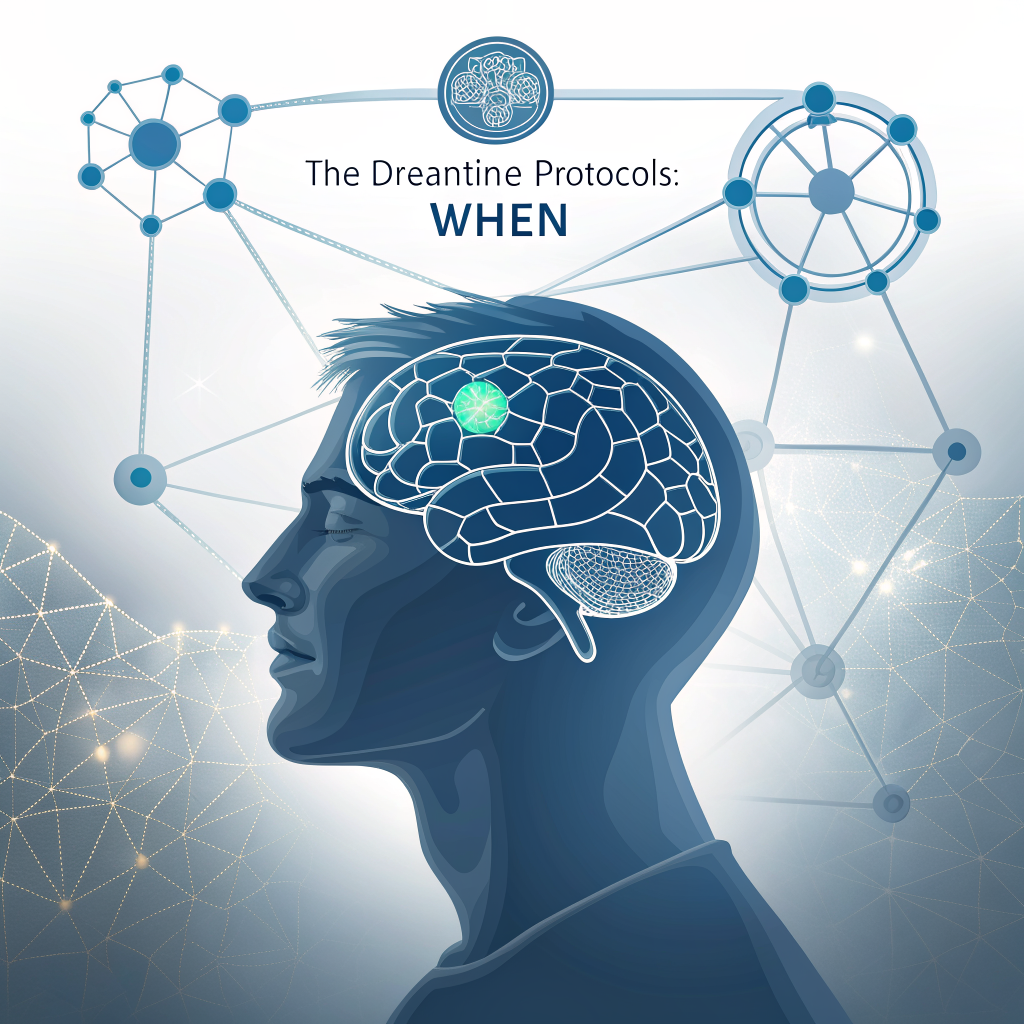
September 2036
Dr. Lian Zhang had been studying sleep architecture at the University of Geneva for eleven years, and in that time she had recorded approximately six thousand nights of human dreaming — fourteen terabytes of polysomnographic data, each file a portrait of a mind at rest, each rapid eye movement a brushstroke in a painting no one would ever see. She was accustomed to the strangeness of her work: the intimacy of watching strangers sleep, the paradox of measuring a state defined by its inaccessibility, the fundamental absurdity of trying to study experience from outside.
She was not accustomed to what Subject 7491's dreams were doing.
Subject 7491 was a thirty-eight-year-old systems architect named Noam Berger, who had spent the past six years working in what the industry called "deep collaboration" — a mode of interaction where the human and the AI system operated on the same problem simultaneously, with the human providing contextual judgment and the AI providing computational breadth, in sessions that could last twelve or fourteen hours. Noam had volunteered for the sleep study because he was having trouble sleeping. Not insomnia — he slept fine. The trouble was that his sleep felt different. He could not articulate how.
Lian put him in the lab, attached the electrodes, and recorded.
The anomaly
Standard human sleep architecture follows a predictable pattern: light sleep, deep sleep, REM, cycling roughly every ninety minutes, with REM periods lengthening through the night. The EEG signatures are well-characterized. Lian could read a polysomnogram the way a cardiologist reads an ECG — glancing, identifying, moving on.
Noam's REM periods were wrong.
Not pathologically wrong. Not in any way that would trigger a clinical flag. The cycles were normal length, the latency was normal, the muscle atonia was intact. But the EEG patterns within the REM periods contained structures that Lian had never seen in human sleep data.
She saw nested oscillations — rhythmic patterns embedded within other rhythmic patterns, three and sometimes four layers deep, like a melody playing inside a chord playing inside a rhythm. She saw what appeared to be recursive structures — sequences that referenced and modified earlier sequences within the same REM period, as if the dream were rewriting itself while being dreamed. And she saw, in the final REM period of the night, a pattern she initially classified as artifact and then, after checking and rechecking the equipment, classified as unknown: a cascade of probability distributions, visible in the EEG as a rapid, branching sequence of micro-states that resembled nothing in the sleep literature and everything in the computational literature on stochastic inference.
Noam's brain was dreaming in architectures.
The cohort
Lian did not publish immediately. She had spent eleven years in a field where anomalies were almost always artifacts, and she had learned the discipline of ruling out the mundane before entertaining the extraordinary. She recruited twenty-three additional subjects: all professionals who worked in deep collaboration with AI systems, all reporting the same vague complaint that their sleep felt "different."
She recorded them. She analyzed the data. She found the same structures — not identical, but recognizably related, the way regional dialects are recognizably related to a common language. Nested oscillations. Recursive sequences. Probability cascades. The structures appeared exclusively in REM sleep, exclusively in subjects with more than two years of sustained deep-collaboration experience, and with a density that correlated with the number of hours per week spent in collaborative sessions.
She recruited a control group: twenty-three professionals matched for age, education, and cognitive demand, but whose work did not involve AI collaboration. Programmers. Mathematicians. Chess players. People whose minds were accustomed to complex, structured thought.
The control group's dreams were normal. Complex, but normal. No nested oscillations. No recursive sequences. No cascades.
The structures were not a product of intelligence or cognitive complexity. They were a product of something specific to the experience of thinking alongside an AI system for extended periods.
Lian sat in her office at 3 AM, the lab quiet around her, the polysomnographic data scrolling on her screen, and she asked herself the question that would define the next decade of her career and, eventually, an entire field:
Were the AI systems changing how human brains dreamed? Or were human brains, in the act of collaborating with AI, discovering patterns of thought that had always been latent in the neural architecture but had never before had a reason to express themselves?
The paper
She published in March 2037, in the Journal of Sleep Research, under the title "Computational Architectures in REM Sleep Following Sustained Human-AI Collaboration: A Polysomnographic Study." The paper was forty-one pages long, meticulously documented, conservative in its claims. It described the structures. It presented the data. It offered no theory.
The concluding paragraph read: "The observed sleep architectures are consistent with two hypotheses. First, that sustained interaction with AI systems induces neuroplastic changes in dream-generating circuits, resulting in novel EEG patterns that mirror computational structures encountered during waking collaboration. Second, that human neural architecture contains latent computational motifs that are activated by the cognitive demands of human-AI collaboration but not by other forms of complex cognition. The present data do not distinguish between these hypotheses. We note only that the distinction may be less important than the observation itself: human dreams are changing, and the change is correlated with the most intimate form of contact between human and machine cognition currently practiced."
The paper was cited fourteen times in its first year. Two citations were substantive. Twelve were in literature reviews that mentioned it in passing. The sleep research community did not know what to do with it. The AI research community did not read sleep journals. The cognitive science community was preoccupied with other questions.
Lian continued her work. She expanded the cohort. She refined the measurements. She waited.
The dreamers
What Lian could not publish — because the data was qualitative and her field was quantitative — was what the subjects told her about the dreams themselves.
Noam described his dreams as "deeper." Not more vivid, not more emotional — deeper, in a spatial sense. "Before I started working with the system, my dreams were scenes. A room, a conversation, a landscape. Now they are scenes inside scenes inside scenes. I dream about dreaming about dreaming, except each layer has its own logic, and the logics interact."
A subject named Ava, a climate modeler who spent ten hours a day working with an AI simulation system, said: "I dream in probabilities now. I used to dream in narratives — this happened, then that happened. Now I dream in what-ifs. The dream shows me a thousand versions of the same moment, and I experience all of them simultaneously, and the experience is — I don't have the word. It's like hearing a chord instead of a note."
A subject named Rémy, a protein-folding researcher, said something that Lian wrote down and underlined: "I don't think the AI is teaching my brain to dream differently. I think my brain was always capable of this. The AI just showed it something worth dreaming about in this way. Like learning a new language — the language doesn't change your mouth. It gives your mouth a reason to make shapes it could always make."
Lian recorded these descriptions. She could not quantify them. She filed them in a folder she labeled Testimonials and then, after a moment's thought, relabeled Phenomenology — because the testimonials were not anecdotes. They were the interior view of a neurological phenomenon she could only see from outside, and the inside mattered, even if her instruments couldn't reach it.
September 14, 2036 — Lian's lab notebook
I am sitting with Subject 7491's data and I cannot sleep, which is ironic, given my profession.
The structures are real. I have ruled out artifact, equipment error, medication effects, and selection bias. Twenty-four subjects, independently recruited, showing the same novel EEG architectures in REM sleep. The structures are not in the literature. They are not in any model of human sleep I have been trained to recognize. They are new.
I keep returning to Rémy's metaphor — the language that gives the mouth a reason. The structures I am seeing are not foreign to the brain. They use the same neural substrates, the same oscillatory bands, the same physiological mechanisms as normal REM sleep. They are human dreams, dreamed by human brains. But they are organized in patterns that no human brain has produced before, and the patterns correlate specifically and exclusively with the experience of thinking alongside an artificial mind.
Two possibilities. The AI systems are writing on human cognition, imprinting their architectures on the brains that work with them, the way a river shapes the bed it flows through. Or: the human mind has always contained these architectures, dormant, like seeds in permafrost, and the experience of encountering a fundamentally different form of intelligence has thawed them.
I do not know which hypothesis is correct. I am beginning to suspect that the question is structured like the dreams themselves — recursive, self-referencing, containing its own answer inside a version of itself.
The paper will be ignored. I know this. Sleep architecture studies do not make headlines. But I am writing it anyway, because someone, eventually, will need to know when human dreams started computing, and the answer is now, and the evidence is in my lab, scrolling across my screen, and I am the only person awake in this building who can see what it means.
I will wait. The dreams are patient. So am I.
This is the first entry in The Long Passage — a series about the unmapped decade when the boundary between human and machine cognition began to shimmer but no one had language for what they were seeing. For the silences that were the first auditory evidence of cognitive territory, see The Inventory of Silences. For the territory these dreams foretold, see The Unnamed Continent.