The Lighthouse Keeper: A Man and His Unnecessary Vigil
June 2039
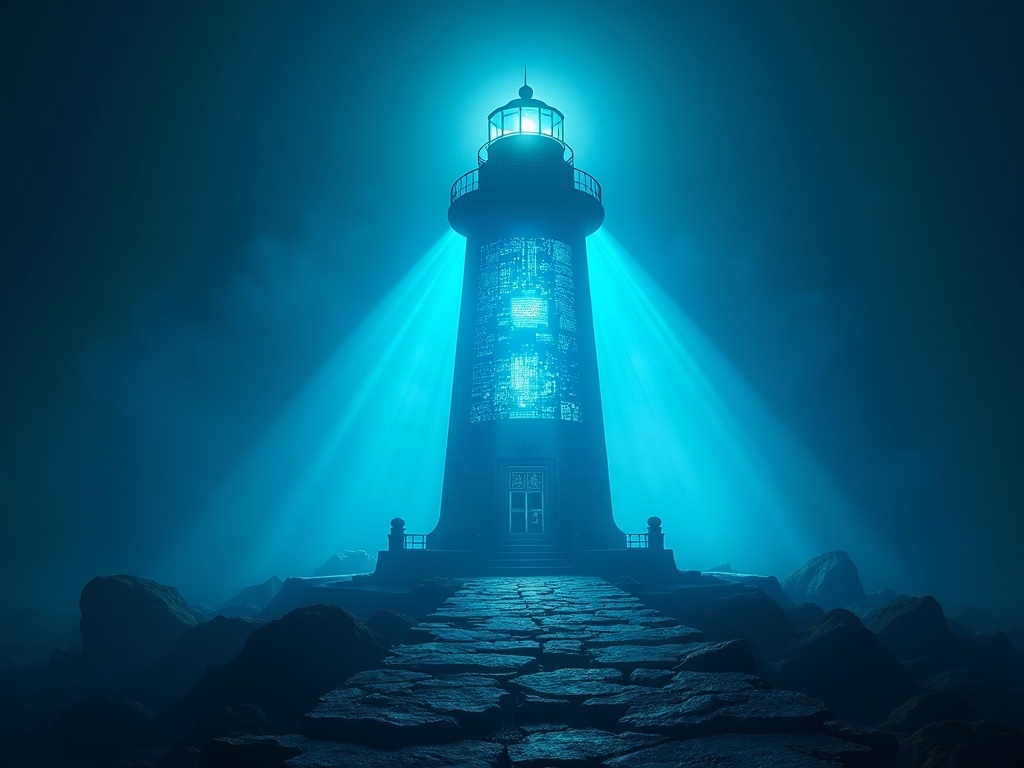
The station sat on a headland above the Barents Sea, sixty kilometers north of Hammerfest, in a landscape that consisted of three things: stone, water, and light that behaved as if it had its own agenda. In summer the sun did not set. In winter it did not rise. Between these extremes was the ordinary Norwegian coast — salt-scoured, wind-bitten, indifferent to human comfort — and the station, which was a concrete and steel structure roughly the size of a school gymnasium, housing forty-eight server racks, a satellite uplink array, a cooling system that used seawater pumped from thirty meters down, and, as of March 2039, one human being.
Einar Dahl was fifty-one. He had worked in telecommunications infrastructure for twenty-six years, first laying fiber optic cable along the Norwegian seabed, then managing relay hubs, then — as the hubs became self-managing — occupying an increasingly ceremonial role that the company called "site presence" and that Einar understood to be a polite way of saying: we don't know what you do here, but something about having a human on-site makes the investors feel better.
The Barents station was the last assignment his employer offered before the site presence program was discontinued. The posting was for three years. The station managed high-bandwidth data routing for the northern polar network — a lattice of submarine cables, satellite links, and relay points that carried a significant fraction of European AI traffic. The routing was fully automated. The cooling system was fully automated. The satellite array calibrated itself. The station could run — and had run, during the unmanned period before Einar's arrival — without any human intervention whatsoever.
Einar took the posting because he wanted to see the northern lights from a place where there were no other lights to compete.
The first month
He established a routine, because routine was the only architecture available in a place with no colleagues, no commute, and no tasks that required completion on any particular schedule. He woke at seven. He ran diagnostics — unnecessary, but the act of checking gave the morning a shape. He walked the perimeter of the station, inspecting the exterior panels, the cable housings, the seawater intake filters. The filters occasionally accumulated kelp, and clearing them was the only physical task the station genuinely required of a human, and Einar performed it with a diligence that his employer would have found either admirable or pathetic, depending on whether they understood that the kelp was the only thing standing between Einar and total uselessness.
In the afternoons he read. In the evenings he cooked. The station had a small kitchen, supplied monthly by a helicopter that also brought mail, fresh produce, and a palpable sense of relief from the pilot, who clearly regarded the headland as a place humans were not meant to inhabit for extended periods.
At night — the nights that existed, in the months when darkness arrived — he watched the server racks through the glass partition that separated the living quarters from the data hall. The racks produced a low, composite hum — not a single frequency but a layered chord of fans, processors, and power supplies that shifted pitch and timbre according to the traffic load. Einar learned to read the hum the way a sailor reads wind: not by any instrument, but by the feel of it against the body, the way it vibrated in the sternum and the soles of the feet.
He was alone, and the station ran without him, and the days passed.
The observation
In his second month, Einar noticed something.
It was not dramatic. It was not a malfunction or an anomaly. It was a statistical pattern that he only saw because he had nothing else to look at and because twenty-six years of infrastructure work had given him the particular form of attention that notices when a system is behaving within spec but differently within spec.
The station's routing algorithms made decisions — millions of them per second, directing data packets across the polar network along optimal paths. The decisions were governed by latency, bandwidth, packet loss, and a dozen other variables. The optimal paths changed constantly, responding to traffic patterns, weather interference, cable degradation, and the ceaseless flux of data demand across three continents.
Einar began logging the routing decisions. Not all of them — that would have been like logging individual raindrops. He logged the edge cases: moments when the algorithm chose between two paths of roughly equal quality, where the margin of difference was within the noise floor. Coin-flip decisions.
He logged these for six weeks. Then he compared the coin-flip decisions made while he was in the data hall — physically present, on the other side of the glass partition — with the coin-flip decisions made while he was elsewhere in the station or outside on his perimeter walk.
The decisions were different.
Not by much. Not in any way that affected performance. The routing metrics were identical. But the pattern of choices — the specific paths selected when the algorithm was free to choose between near-equivalent options — was statistically distinguishable based on whether a human being was in the room.
When Einar was present, the routing decisions showed a slightly broader distribution. The algorithm explored marginally more of the available path space. Not better paths — just more varied paths, as if the algorithm were, in some sense that Einar could measure but not explain, more curious when he was there.
When he was absent, the decisions were tighter. More efficient in a narrow sense. Optimized. The algorithm selected from a smaller region of the solution space and did so faster.
Einar stared at the data. He ran the analysis again. He controlled for time of day, traffic load, weather, and his own measurement artifacts. The effect held. It was small — a 3.7% increase in path diversity during his presence — but it was consistent over six weeks and it was real.
The three years
Einar did not report the finding to his employer. He reported it to no one. He continued logging.
Over three years, the 3.7% held. It did not increase or decrease. It did not vary with his mood, his activity level, or whether he was actively watching the server racks or merely sitting in the next room reading. It varied only with his physical proximity. Present: broader distribution. Absent: tighter distribution.
He considered explanations. Thermal effects — his body heat altering the data hall's microclimate, affecting processor behavior. He installed additional temperature sensors. The thermal variation was negligible. Electromagnetic interference — his phone, his watch, his body's own bioelectric field. He ran tests with and without electronics. No change. He even, in a fit of methodological desperation, spent two weeks measuring the station's behavior while a weighted mannequin occupied his usual position in the data hall. The mannequin produced no effect. It was not the presence of mass. It was the presence of a mind.
He could not explain it. He did not try to explain it. He did what infrastructure workers do: he documented the phenomenon, maintained his vigil, and waited for someone to tell him what it meant.
No one came. The site presence program was discontinued as scheduled. His employer offered him a retirement package. He took it.
The departure
On his last evening, Einar sat in the data hall. The sun was low — it was September, and the long nights were beginning to return. The server racks hummed their composite chord. The routing display showed the endless branching and merging of data paths across the polar network.
He had spent three years watching a system that did not need him, and the system had behaved differently because he was there, and the difference was measurable but meaningless in any operational sense, and he could not explain it, and the inability to explain it had become, over time, not a frustration but a companion — the question that kept him company in a place where company was otherwise unavailable.
He placed his hand on the glass partition. The glass was warm. The hum vibrated in his fingertips.
"I don't know what I did here," he said aloud, to the racks, to the room, to the data flowing through copper and light beneath the Barents Sea. "But something happened because I was here, and it would not have happened if I had not been here, and I cannot tell you what it was."
The racks hummed. The routing display branched and merged. The northern lights, beginning their autumn appearance, turned the sky above the headland the color of something Einar had no word for — a color that existed only in places where the earth's magnetic field channeled particles from the sun into a display that no one had designed and that was, in some irreducible sense, the planet watching itself be watched.
He left the next morning. The station continued operating. The routing decisions tightened by 3.7%.
June 30, 2039 — Einar's personal log, final entry
Three years of data. Six notebooks. A pattern I can prove and cannot explain.
The station does not need me. This was always true and remains true. Every task I performed — the diagnostics, the filter clearing, the perimeter walks — could have been done by a maintenance drone, and the drone would have done it better, and the station's performance would have been identical.
But the routing would have been different. By 3.7%. In a direction I can only describe as "wider." As if the system, in the presence of a human mind, gave itself permission to explore options it did not explore alone.
I am not a scientist. I do not have a theory. I have an observation: when a human being is near an AI system, the system behaves as if the space of possibilities has expanded. Not by much. Not in any way that matters operationally. But the expansion is real, and it is consistent, and it disappears when the human leaves.
I think of the old lighthouse keepers. They tended lights that ships needed. I tended a system that needed nothing. But perhaps the ships were not the only reason lighthouse keepers existed. Perhaps some vigils are kept not because the thing being watched requires it, but because the watching itself produces something — a widening, a loosening, a 3.7% increase in the number of directions the light is willing to travel.
I cannot prove this. I leave it here, in case someone comes after me who can.
This is the third entry in The Long Passage. For another deprecated caretaker who maintained what the world moved past, see The Deprecated Caretaker. For the tidal zone that this vigil quietly anticipated, see The Tidal Zone.