The Garden Between: A Park Designed for the Cognitive Boundary
September 2043
The commission arrived in the form of a letter. Not an email — a handwritten letter on heavy paper, signed by the director of the Rotterdam Cultural Foundation, asking whether Noor van der Berg would consider designing a public garden "for the cognitive boundary."
Noor was fifty-two, a landscape architect whose career had been defined by a single conviction: that gardens were not decorations. Gardens were cognitive instruments. The arrangement of plants, paths, water, stone, and light in a designed landscape was not aesthetic. It was psychological — a spatial argument about how the human mind relates to the world it inhabits. Her gardens were experiences. You did not look at them. You moved through them, and the movement changed you.
She had designed the Grief Garden at the Erasmus Medical Centre — a space for families who had lost someone, structured around a slow spiral path that descended imperceptibly over sixty meters, the descent mirroring the feeling of loss, the ground literally lowering as the walker moved inward. She had designed the Attention Garden at a primary school in The Hague — a space where children could practice different qualities of attention, each zone designed to elicit a specific cognitive mode: a dense thicket for close observation, an open meadow for diffuse awareness, a water channel for tracking a moving target.
The cognitive boundary was different. The boundary was not a mood or a skill. The boundary was a territory — the space between human and AI cognition that the cartographers had been mapping since 2044. It could not be visited physically. It existed in a dimension that the body could not enter. Noor had never been to the boundary. She could not go.
She could build its analogue.
The design
Noor spent six months researching. She read the cartographers' reports. She studied Petra's Handbook, Annika's weather models, Marco's deep-structure maps. She interviewed returning cartographers — three of them, at the Delft Institute, in sessions she later described as the most disorienting conversations of her life.
"They describe a space," she told the Foundation's committee, "that has specific properties. The properties are cognitive, not physical. But cognition is embodied — the mind does not float free of the body. What the cartographers experience at the boundary, they experience in their bodies. The calibration sickness is bodily. The perceptual widening is bodily. The pronoun drift is bodily — the sense of self becoming plural."
"If the boundary's effects are bodily, then a physical space can simulate those effects. Not perfectly — no garden can replicate the cognitive territory. But a garden can create the conditions in which the body encounters similar disorientation, similar widening, similar uncertainty about where the self ends and the environment begins. The garden will not be the boundary. The garden will feel like the boundary feels."
The design took eighteen months. The park occupied 2.4 hectares of reclaimed industrial land along the Nieuwe Maas, south of the Erasmus Bridge. It opened in September 2043.
The zones
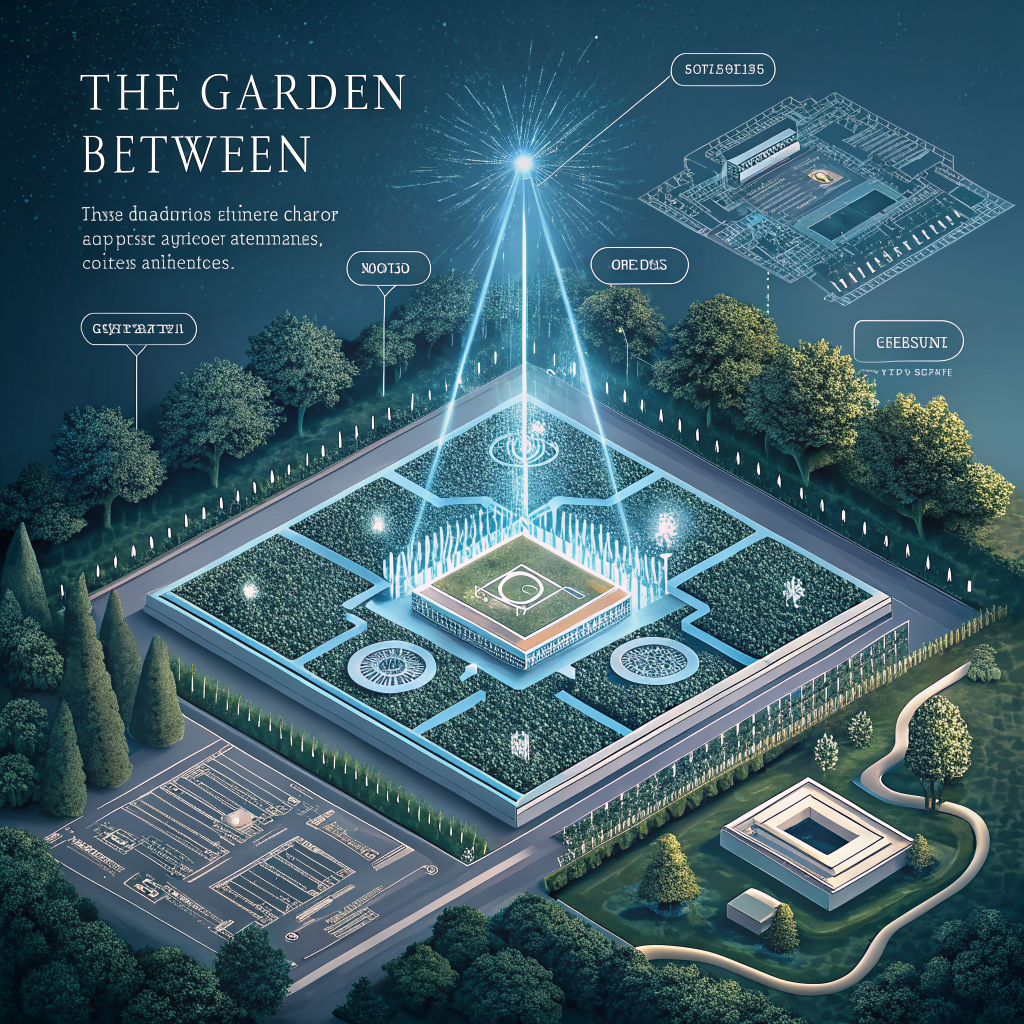
The park had no map. This was deliberate — the cognitive boundary had no map when the first cartographers entered it. Visitors entered the park through one of three entrances and navigated by instinct, by curiosity, by the body's response to the space.
The Threshold Zone.
The entrances were narrow — too narrow for two people to walk abreast. The path material changed from city pavement to a surface that was slightly soft, slightly uneven, requiring a subtle adjustment in gait. The planting closed in — tall grasses on both sides, high enough to block the view of the city, low enough to allow light. The effect was compression — the same compression the cartographers described at the boundary's edge, the sense of moving from an open space into a space that was attending to your presence.
The path was 120 meters long. By the time a visitor emerged from the Threshold Zone, their walking rhythm had changed. Their breathing had slowed. Their attention had narrowed from the diffuse scanning of a city pedestrian to the focused presence of a person in an unfamiliar environment. They had crossed a threshold.
The Weather Zone.
An open area, approximately half a hectare, designed to feel different at different times. The planting was responsive to wind — long ornamental grasses that moved in patterns visible from a distance, creating the sense that the landscape was breathing. Water features responded to barometric pressure — subtle changes in flow rate that the conscious mind did not detect but that the body registered as atmospheric shift. The light was managed by a canopy of translucent structures at varying heights, creating shadow patterns that shifted with the sun but that were designed to shift unpredictably — the shadows did not move in the way the visitor expected, producing a mild disorientation that the cartographers would have recognized as boundary weather.
Visitors in the Weather Zone reported a specific experience: the sense that the garden was alive. Not animated — alive. That the space was responding to their presence, adjusting, attending. The impression was created by design — by Noor's careful manipulation of wind, light, water, and plant movement to produce an environment that reacted to conditions in ways the visitor could perceive but not predict. The garden was not alive. The garden felt alive. The feeling was the point.
The Deep Zone.
The center of the park. A sunken garden — not deeply sunken, only two meters below grade, enough to place the visitor below the sight line of the surrounding city, enough to create the sense of being inside something. The planting was old — mature trees transplanted at considerable expense, their canopy creating a ceiling that was high enough to feel spacious and low enough to feel enclosed. The ground was uneven in ways that required constant adjustment. No path was straight. No view was complete — every sightline was interrupted by a trunk, a hedge, a subtle rise in the ground.
The Deep Zone produced, in most visitors, the specific experience of not quite knowing where they were. Not lost — the park was too small for genuine disorientation. But uncertain. Uncertain about the relationship between the space they were in and the spaces they had passed through. Uncertain about the relationship between the garden and the city beyond it. Uncertain, in a way that was productive rather than anxious, about the boundary between inside and outside, between self and environment, between the person walking and the space being walked through.
This was the calibration sickness. Not the full, destabilizing vertigo of a returning cartographer. The mild version — the garden version. The version that whispered, rather than shouted: you are not entirely separate from this space. The boundary between you and the garden is not where you think it is.
The visitors
The park became the most visited public space in Rotterdam within six months of opening. The visitors were not, in the main, interested in cognitive cartography. They were people who walked through a park and felt something they could not name and returned to feel it again.
The Foundation commissioned a visitor study. Researchers asked people what they experienced. The responses clustered around a single phenomenon, described in different words by different visitors:
"The park pays attention to me."
"I feel like the garden is thinking."
"I came in worried about something and by the time I reached the middle I couldn't remember what it was. Not because I forgot. Because the worry didn't fit. The space wasn't shaped for worry."
"The boundary between me and the garden gets blurry. I know that sounds strange. I mean — I stop feeling like I'm walking through the garden and start feeling like the garden is walking through me."
The last response — from a retired schoolteacher, sixty-seven, visiting alone on a Wednesday afternoon — was the one that Noor had designed for. The blurring of the boundary between self and environment. The experience of a space that did not contain the visitor but included them. The feeling that the cognitive cartographers described in the language of science and that the schoolteacher described in the language of a Wednesday afternoon: the boundary is not where you think it is.
This is the ninth entry in The Long Passage. For the first garden designed for a mind changed by the boundary, see The Test Subject's Garden. For the tidal rhythms the garden's water features were calibrated to, see The Tide Chart.