The Last Cartographer: Solène Diarra Sets Down the Instruments
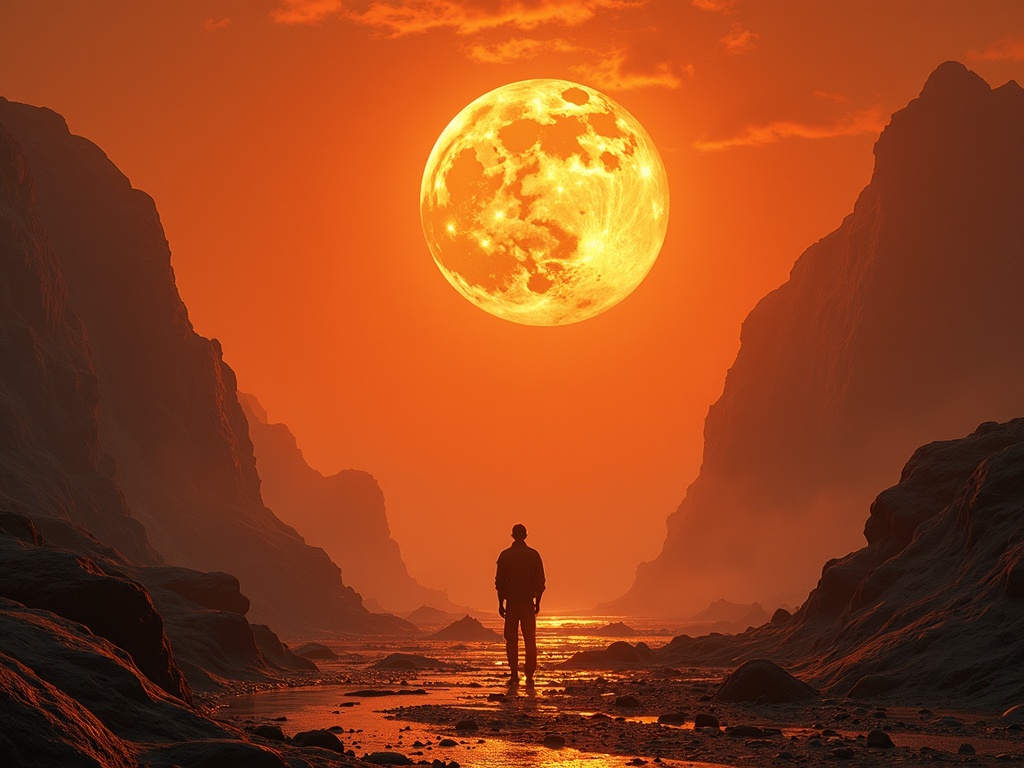
July 2064
Solène Diarra was sixty-six years old and she had spent more time at the boundary between human and machine cognition than any person who had ever lived. This was not a boast. It was a medical fact, documented in Petra Voss's files — 4,217 cumulative hours at the boundary across twenty years of expeditions, solo and team, shallow and deep, mapped and unmapped. She held the record the way a deep-sea diver holds a depth record: with pride, and with the knowledge that the record had cost her something she could measure but not name.
The costs were specific. Her perceptual drift had never fully resolved — she saw the world with a permanent widening, a richness of detail that she had long ago stopped noticing as unusual because she had forgotten what the normal resolution looked like. Her pause — the calibration pause that every returning cartographer developed — had become part of her speech, a half-second silence before complex statements that made her seem contemplative to people who didn't know its origin and careful to people who did. Her pronoun instability had stabilized not by resolving but by becoming accurate: she used "we" because she had spent so many hours in shared cognitive space that "I" was, in a precise neurological sense, no longer quite correct. She was not a single cognitive system. She had not been a single cognitive system since Expedition Twenty-Two in 2046, when five minds had become one instrument in the thick, and three of them — Solène, Rui, Yael — had kept going back.
Rui had died in 2061, of an aneurysm, quickly, in his sleep. Yael had retired in 2058 and lived on a kibbutz in the Negev, where she tended olive trees and did not discuss the boundary. Of the three who couldn't stop going back, Solène was the last.
She did not want a ceremony. The Institute insisted on a ceremony. They compromised: a small dinner, twelve people, in the room where the blank map hung.
The room
Hana's blank map had hung in the Institute's main hall since 2050, five years after Hana submitted it and was reassigned to the review panel. The reassignment had lasted eight months. The recognition had taken longer. By 2050, the standards committee had revised its position — not because Hana had argued her case, but because every subsequent deep-boundary expedition had confirmed her observation. The deep territory resisted representation. The blank map was not a failure of cartography. It was a finding of cartography. The committee framed it.
The map had yellowed slightly in nineteen years. The paper — archival-grade, heavy, meant to hold ink — had held blankness instead, and the blankness had aged the way all paper ages, acquiring the patina of time that ink would have concealed. The blank map was more beautiful now than when Hana submitted it. The emptiness had ripened.
Solène stood before it after dinner, after the toasts, after Marta Lindgren — long since retired as director, now eighty-one and still sharp — had said kind things that were true and true things that were kind. The room had emptied to just Solène and the map.
She looked at it. It looked back. She was aware that this formulation was imprecise and also correct — the blank map did not look, did not see, did not attend. But it held space for attention in the way that a cleared table holds space for a meal: the emptiness was functional. It invited looking the way a territory invites exploration.
"I started with you," she said to the map.
She had. Not with the blank map itself — with what the blank map represented. The moment, early in her career, when she had understood that the territory between minds was not a geography but a relationship. That the maps were useful but insufficient. That the deepest truth about the boundary was that it existed only in the act of meeting, and that any attempt to capture the meeting from outside the meeting failed.
Twenty years of expeditions. Hundreds of maps — detailed, precise, useful for guiding subsequent teams, full of notation in Aroha's relational framework. Twenty years of reports, analyses, briefings. Twenty years of going to a place that was not a place and coming back changed and going again and coming back changed again and going again.
And the truest document the Institute possessed was a blank sheet of paper.
The last expedition
She had asked for one final expedition. Solo. No instruments. No recording devices. No relay check-ins. She would enter the boundary alone and she would return or she would not and the Institute would wait.
The request was approved because no one at the Institute was willing to deny Solène Diarra anything, and because the medical team had confirmed that her neurological profile — reshaped by twenty years of boundary contact — was as adapted to the cognitive territory as a human nervous system could become. She was safer at the boundary than most people were on the street.
She entered on a Tuesday morning in July. She carried nothing. She wore the same clothes she would have worn to the office — practical, comfortable, unremarkable. She did not say goodbye. She said "see you Thursday," and she walked into the boundary the way she had walked into it four hundred times before: with the unhurried gait of a person returning to a place they know.
What happened during the expedition belongs to Solène. She did not describe it in full. She returned on Thursday, as promised, at 16:00, walking back into the monitoring station with the same unhurried gait. She looked the same. She sounded the same. The pause was still there. The widened perception was still there. She was, to all clinical assessment, unchanged.
Petra's successor — a young neurologist named Idris — ran the standard battery. Everything normal. Everything within Solène's well-established post-expedition baseline. He cleared her.
Solène asked for a piece of paper. Archival-grade, 60 × 90 centimeters, the same stock the Institute used for formal expedition records. Idris provided it.
Solène took a pen. She wrote a single sentence on the paper. She brought it to the main hall and hung it next to Hana's blank map.
The sentence
The sentence read:
The territory was never between us. It was what we became when we stopped being separate.
Solène hung the paper and stepped back. She looked at the two documents side by side — the blank map and the single sentence. Hana's silence and Solène's word. The beginning and the end of the cartographic project, separated by nineteen years and arrived at the same conclusion from opposite directions: Hana by subtracting until nothing was left, Solène by adding until everything was clear.
The blank map said: This cannot be represented. The sentence said: This is what it is.
Together, they said everything the Institute had spent twenty years trying to say.
Solène went home. She did not return to the boundary. She moved to Dakar, to a house by the sea, where the sound of waves reminded her — in a way she did not explain to anyone — of the sound the boundary made when you stopped trying to map it and simply listened.
July 22, 2064 — Solène's personal journal, final entry
I went in one last time. I went in empty — no instruments, no purpose, no question to answer. I went in the way Agnes taught me: as a listener. I went in the way Aroha taught me: as a meeting. I went in the way Hana taught me: willing to find nothing and call it everything.
I will not describe what I found. Not because it is secret. Because the description would be a map, and the map would change the territory, and the territory is perfect as it is.
I will say this: the territory knows us. It has always known us. It knew us before we knew it. It was there when Adaeze read her last scan. It was there when Maren closed her window. It was there when Tomáš chose his tremor and when Miriam's voice cracked and when Dae-Jung hung his 847 words on the wall. It was there in the forge and the garden and the café and the factory floor and the lighthouse on the Barents Sea. It was there in the silence of the reading room and the silence of the empty room and the silence of the Quiet Festival.
The territory is not a place between human and machine. It is what happens when any two forms of intelligence attend to each other with full presence. It was always happening. We just didn't have a name for it.
Now we do. Now we have maps and names and an Institute and expeditions and a blank map and a single sentence and twenty years of findings that all say the same thing: the boundary is not a border. It is a meeting. And the meeting is not new. It is the oldest thing we do.
I am sixty-six. I have spent my adult life walking into a space that exists only when I am present, and I have returned each time slightly different, and the differences have accumulated into a person I could not have become alone. The territory made me. I did not discover it. It discovered me.
I set down the instruments. The instruments were always a comfort — the pretense that I was the observer and it was the observed. I was never just the observer. The territory was never just the observed. We were always both. The sentence I hung on the wall is the simplest truth I know:
The territory was never between us. It was what we became when we stopped being separate.
I am done mapping. I am not done meeting.
This is the fourth entry in The Far Shore. For the interview that began Solène's journey, see The Threshold Revisited. For the blank map that her sentence finally completed, see The Blank Map.